Title: A Quiet Place
Author: Seicho Matsumoto
(Translated by Louise Heal Kawai)
Year: 1971
Country: Japan
Format: Paperback
Pages: 231
Read: 31 December 2025 – 4 January 2026
First reading
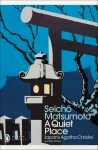
A Quiet Place is a crime thriller by prolific Japanese author Seicho Matsumoto. While away on a business trip, middle-aged bureaucrat Tsuneo Asai receives the devastating news that his younger wife Eiko has died of a heart attack. When he visits the small boutique where she collapsed, Asai is puzzled that his wife never once mentioned visiting the area. Nearby he notices several seedy couples’ hotels—quiet places. Was Eiko leading a double life? And was her death more suspicious than it first seemed?
~ Warning: The following contains significant plot spoilers. ~
The cover of this book describes Seicho Matsumoto as Japan’s Agatha Christie. While that’s true for the other Matsumoto stuff I’ve read, I’d argue A Quiet Place is really more like a psychological thriller by Patricia Highsmith. Asai’s investigations reveal that his wife was having an affair—he’d been too devoted to his job to notice. Eventually he confronts Eiko’s lover and, provoked by the man’s apparent lack of remorse, impulsively murders him. From there, what started as a typical investigation plot pivots into Highsmithian paranoia. It’s an interesting development, and a genre I enjoy, so I’m not disappointed by it. But I do think it’s somewhat misleading to sell it as a Christiesque murder mystery. It’s not so much a whodunit as a howgetawaywithit.
This is a quick and enjoyable read. Matsumoto’s social commentary is interesting—Asai is forced into impossible situations by Japanese social customs and his all-consuming dedication to work. And as a fan (and writer) of haiku, I love that a haiku plays a vital role in the investigation. But it’s not as evocative or as gripping as the other Matsumoto books I’ve read. In fact it’s probably my least favourite Matsumoto book so far. I’d recommend Inspector Imanishi Investigates or Tokyo Express as better starting places.
(Just one more thing: The final scene unexpectedly made me laugh. Asai comes face to face with the very witnesses he’s been trying to avoid, and gives himself away by shrieking and running away. At that moment I couldn’t help but picture him as Homer Simpson!)
 A Genteel Black Hole
Leave a comment