Title: Strangers on a Train
Author: Patricia Highsmith
Year: 1950
Country: USA
Format: Paperback
Pages: 256
Read: 20 – 28 March 2026
Reread
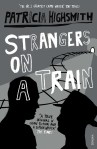
Two strangers, up-and-coming architect Guy Haines and wealthy drunkard Charles Anthony Bruno, meet by chance on a train. As the two men talk it becomes clear that Bruno is obsessed with murder. He outlines his plan for the perfect murder, or rather the perfect pair of murders. Each man would do the other’s dirty work, ensuring there’s no motive connecting him to his respective crime. Bruno even proposes the ideal victims: His father, and Guy’s estranged wife Miriam. Guy protests he’s not the type to commit murder. But Bruno insists there is no “type”, that any man can kill given the right circumstances. And when Bruno goes ahead and strangles Miriam for Guy, it sets in motion a series of events which lead inexorably to Guy fulfilling his half of the bargain.
I first read Strangers on a Train just over a decade ago. Back then I found it faintly underwhelming, perhaps because the fun and thrilling Hitchcock film was fresh in my memory—as was Highsmith’s excellent book, The Talented Mr Ripley. Honestly I’m not really sure what I was thinking. This time I was able to better appreciate Strangers on a Train for what it is… and I loved every second!
This is a remarkable debut novel, much deeper and darker than the film it inspired. It’s a study of the ugliest recesses of the human psyche, exposing how a perfectly ordinary man can be driven to kill. “What else do you think keeps the totalitarian states going?” Highsmith paints both Guy and Bruno vividly, with disturbing insight. Their thought processes are laid out in detail; every paranoid spiral, every hateful and violent impulse. It may lack some of the action set-pieces of Hitchcock’s adaptation*, but it had me constantly gripped by the guts.
The story also has a strong homoerotic subtext. Guy and Bruno share a profound connection, one that must be repressed and hidden at all costs—yet they can’t keep away from each other. Bruno even plies Guy with gifts, desperately seeking his approval. These are compelling, queer, obsessive themes that Highsmith would revisit throughout her career.
I’m not sure why I drifted away from Patricia Highsmith, having initially been so thrilled to discover her. Revisiting Strangers on a Train has suddenly reignited my enthusiasm in a big way. I’m excited to explore more of her books in the future, rereading the ones I remember fondly and trying some new ones too. My reading schedule is already looking pretty full, but I really hope to make time for more Highsmith this year.
*Interestingly, the climactic merry-go-round scene in the Hitchcock film was taken, uncredited, from an entirely different book: The Moving Toyshop by Edmund Crispin.
 A Genteel Black Hole
Leave a comment