Tag: cinema

  • Day 38 of Project Glowing Rectangle, in which I try to divert some of my daily doomscrolling time back towards a more nourishing oblong: Cinema.
    Title: The Apartment
    Director: Billy Wilder
    Writer: Billy Wilder, I. A. L. Diamond
    Year: 1960
    Country: USA

    Format: 4K Blu-ray
    Length: 125 minutes
    Seen: 18 February 2026
    Rewatch

    Kubelik: Some people take, some people get took. And they know they’re getting took and there’s nothing they can do about it.

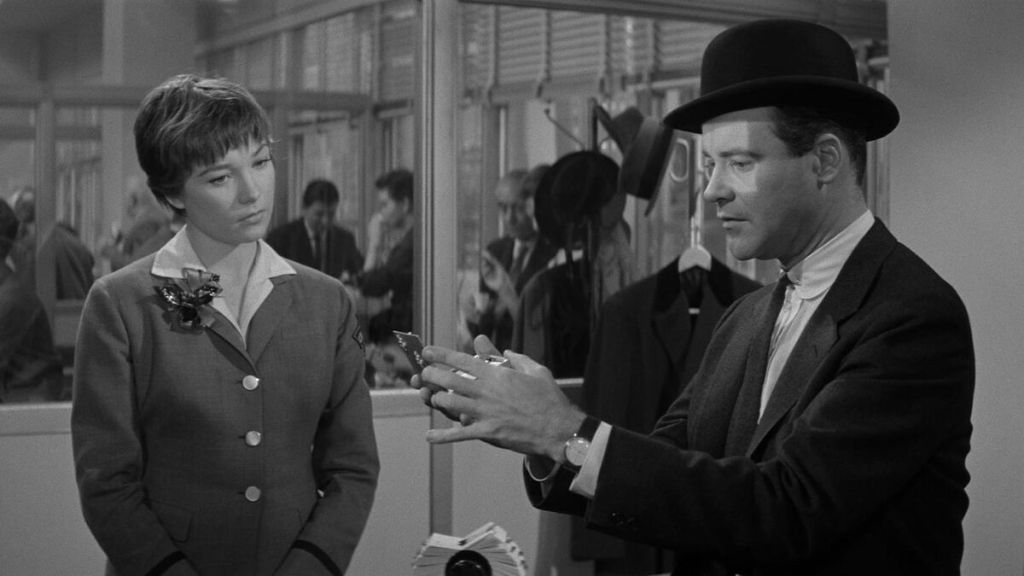
    C. C. Baxter (Jack Lemmon), aka Buddy Boy, is one of those people who gets took. He works in a huge office building as an insurance clerk, his head stuffed with numbers and statistics. Baxter often works late, not out of dedication to his job but because, despite living alone, his apartment is rarely empty. His key gets passed around the office, his apartment serving as a discreet place for married men to take their girlfriends. In return, Baxter’s superiors recommend him for promotions. When he agrees to lend the key to Mr Sheldrake (Fred MacMurray), director of personnel, Baxter finds himself quickly ascending the corporate ladder. Meanwhile he harbours a crush on Miss Kubelik (Shirley MacLaine), an elevator operator at the office. Little does he know she’s already been to his apartment…

    Baxter: The mirror… it’s broken.
    Kubelik: Yes, I know. I like it that way. Makes me look the way I feel.

    It’s safe to say The Apartment is my favourite film of all time. My band’s debut album, The Way It Crumbles, was named after a quote from the film. I rewatched it today to celebrate my 40th birthday and it made me smile, laugh and blub as much as ever! It’s a beautiful film about loneliness, human connection, and the importance of growing a spine and doing the right thing—or, as Baxter’s neighbour Dr Dreyfuss (Jack Kruschen) puts it, being a mensch.

    Jack Lemmon and Shirley MacLaine are fantastic as Baxter and Kubelik, and the screenplay by Billy Wilder and I. A. L. Diamond is a well-oiled machine of setups and payoffs. Baxter has a habit of quoting all the other characters, picking up their verbal tics and mannerisms. This leads to so many running gags and references throughout the film, each one gaining new significance over time. Nobody quotes Baxter in return, at least not at first. But eventually Miss Kubelik starts to pick up Baxterisms and the two are drawn together, romance-wise. It’s a rather chaste romance, one that ends not with a passionate kiss but a game of cards. It feels to me like a very neurodivergent-coded romcom. I love it deeply.

  • Day 32 of Project Glowing Rectangle, in which I try to divert some of my daily doomscrolling time back towards a more nourishing oblong: Cinema.

    Title: The Life of Oharu
    Director: Kenji Mizoguchi
    Writer: Kenji Mizoguchi, Yoshikata Yoda
    (based on stories by Saikaku Ihara)
    Year: 1952
    Country: Japan

    Format: Blu-ray
    Length: 136 minutes
    Seen: 29 January 2026
    First viewing

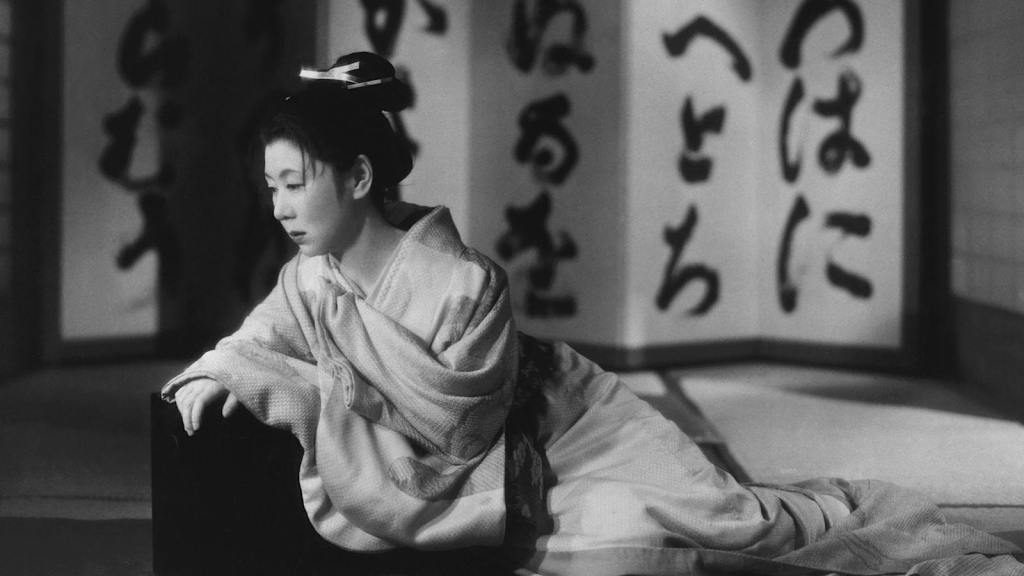
    It’s been a disruptive few weeks, but things have finally settled down enough for me to watch a film: The Life of Oharu (1952), a period drama directed by Kenji Mizoguchi. Kinuyo Tanaka stars as the eponymous Oharu, whose life is one of ever-increasing misery. We are introduced to her as a fiftysomething prostitute, walking the streets and struggling to find a client. She takes shelter in a Buddhist temple where the statues’ faces remind her of figures from her past. What follows is the heartrending story of how she fell from a life of nobility to one of such hardship.

    First an affair with a lowly retainer (Toshiro Mifune) ends with her lover executed and her family banished. Then her father sells her, first to a Lord as a mistress to bear him a child, and later to a pleasure district as a courtesan. From there things only get worse for Oharu, almost always due to circumstances beyond her control. But the film does end with the faintest glimmer of hope… at least if you subscribe to Buddhist philosophy.

    You’re bought and paid for. You’re no different from a fish on a chopping board. We can serve you up any way we like.

    This was my second Mizoguchi film: Ugetsu (also starring Tanaka) was a highlight of last year. Both films are beautifully directed, very gripping, and intensely emotional. But while Ugetsu is a spine-tingling, supernatural tale, The Life of Oharu is horribly realistic. Oharu’s suffering comes not from personal hubris or ghostly tricks, but from the cruel treatment of other people—mainly men. Throughout the whole film I found myself bristling at the sheer injustice of it all.

    Kinuyo Tanaka is brilliant in the title role. I’ve seen her in several films recently, each one displaying a different facet of her talent. (She was also one of Japan’s first female directors, so I’m excited to explore that side of her work too.) As far as Mizoguchi goes I definitely preferred Ugetsu, but I can’t deny this film’s power—it left my heart feeling, like a fish on a chopping board, rather battered!

  • I’ve been tracking my film viewing since 2012. That year, at the height of my obsession, I watched 161 films! By the end of the decade, things had settled down to a more reasonable level, about 50 or 60 per year. But in 2022, due to a mixture of creative projects and health disasters, I watched just 11 films—and for the next couple of years that number didn’t go above 17. With less time spent on films, my doomscrolling ballooned.

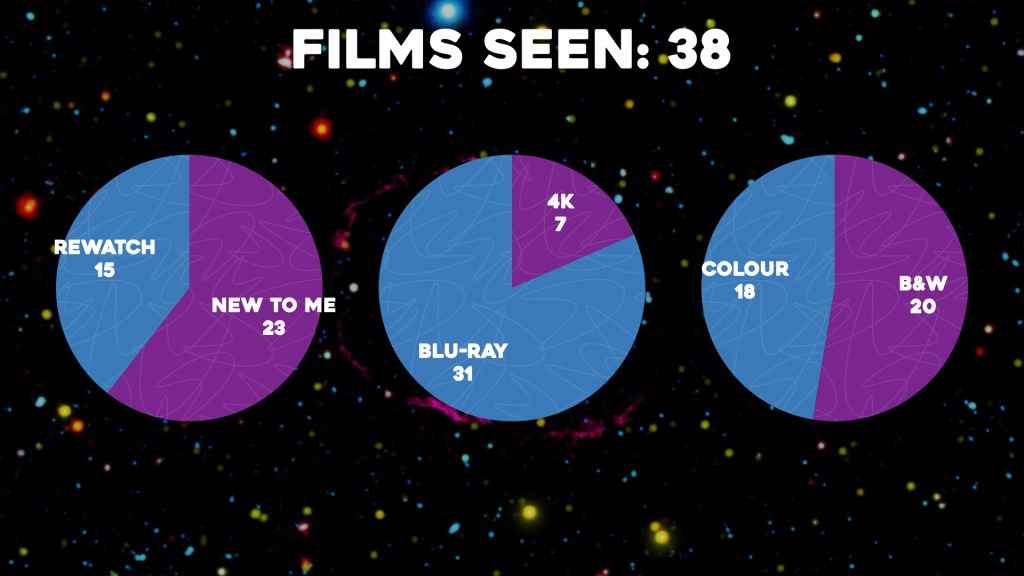
    Enter Project Glowing Rectangle, my personal effort to simultaneously get my phone habit under control and reclaim my love of cinema: Two birds, one Sharon Stone! I started the project in late August 2025. By the end of the year I had watched 38 films, of which only 9 were pre-Rectangle.

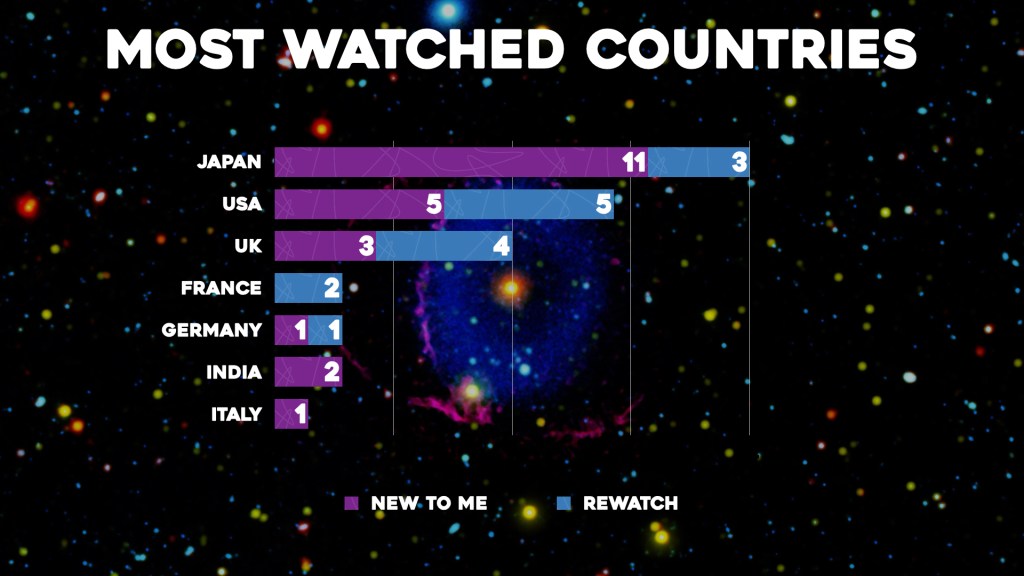
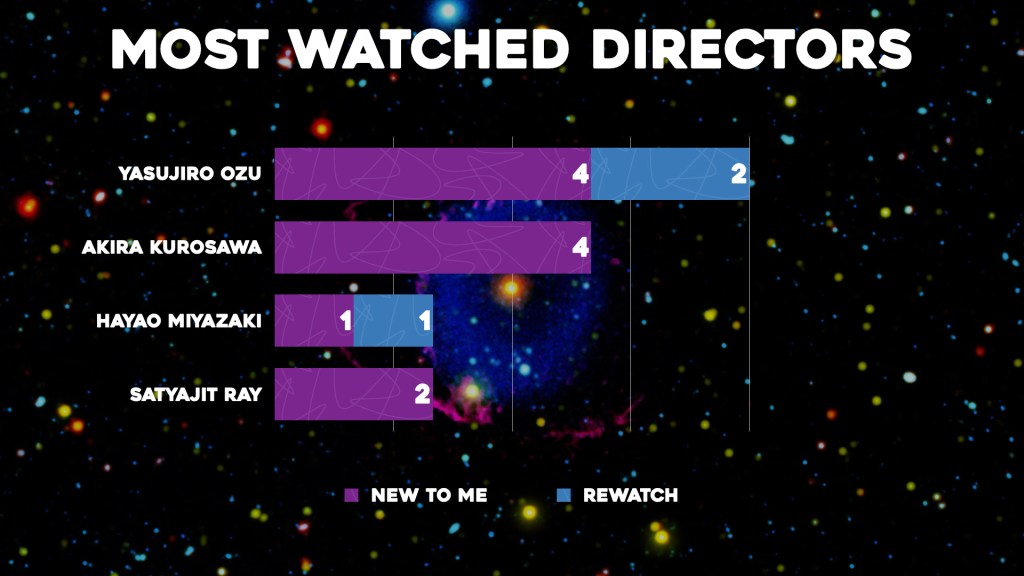
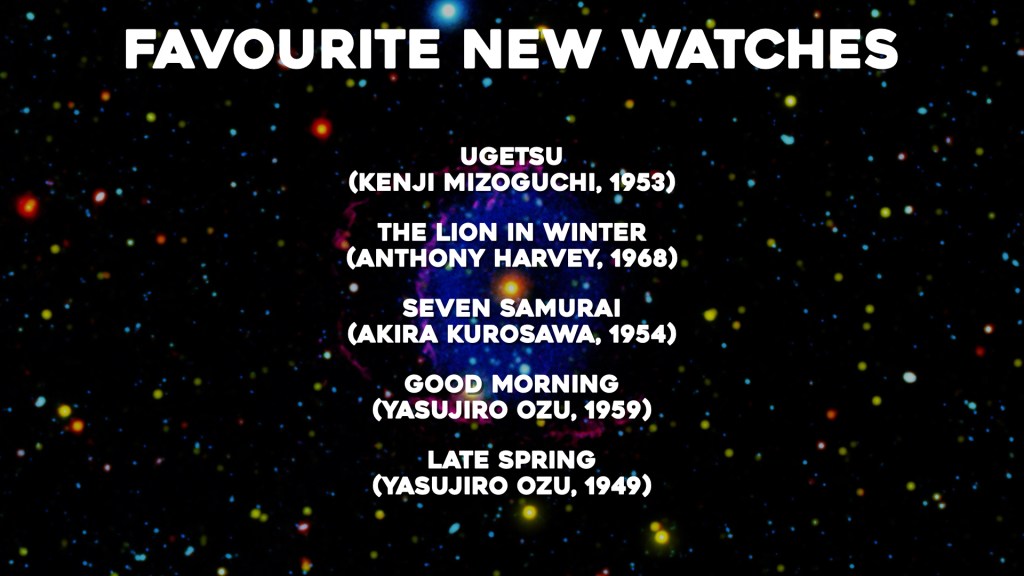
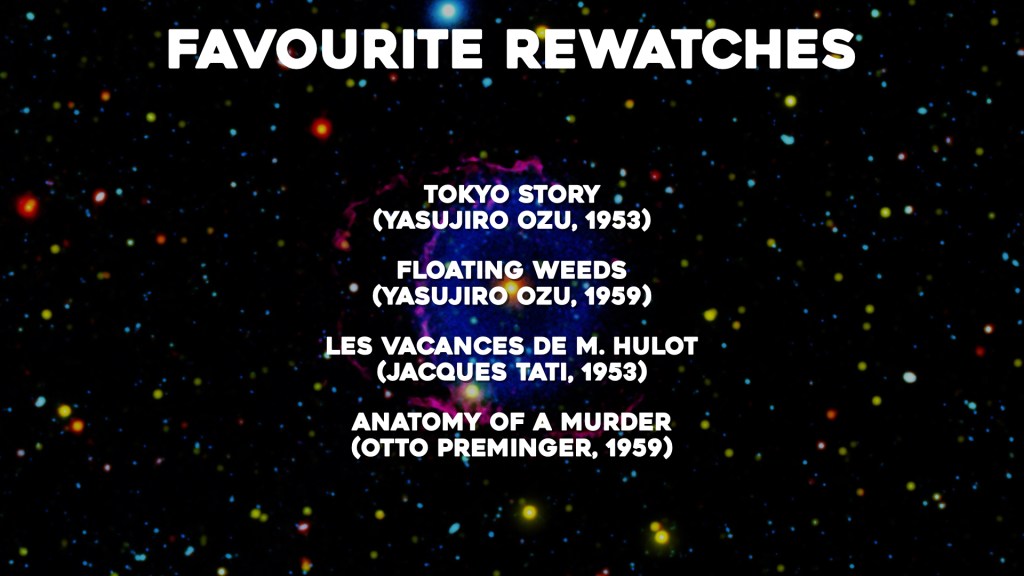
    But numbers don’t tell the whole story. What actually happened is that I fell back in love with cinema. I had several transcendent movie experiences during the year. While my 2010s film binge was kickstarted by the Golden Age of Hollywood, my recent cinematic renaissance had a more Japanese flavour. I started the project with a rewatch of Yasujiro Ozu’s Floating Weeds and ended the year with Kiyoshi Kurosawa’s Cure. And that’s just two of the 14 Japanese films I watched—nearly all of them great! Ugetsu and Seven Samurai were two standouts, both seen for the first time in November. And Yasujiro Ozu has become a real favourite filmmaker for me: I watched the entire Noriko Trilogy and several more besides, and loved them all. I’m excited to explore more of his work in the coming year, as well as more Mizoguchi, Kurosawa, and other Japanese classics on my radar.

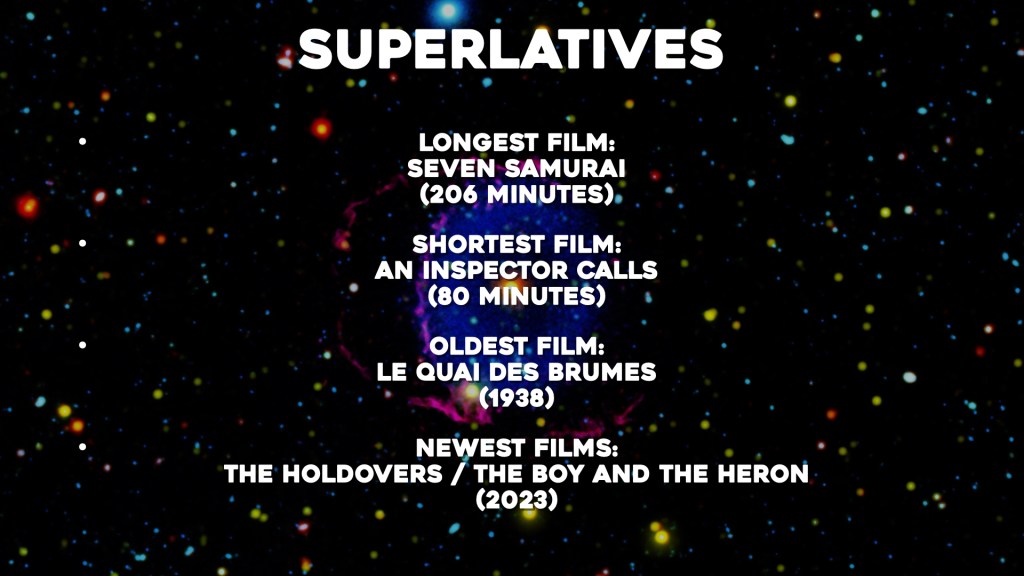
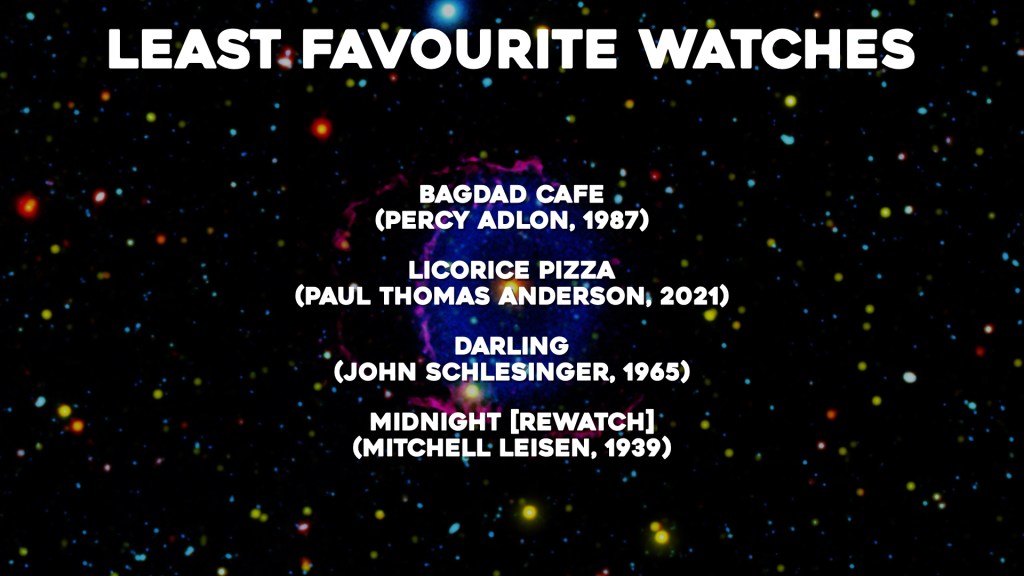
    Most of my biggest disappointments came pre-Rectangle. Miyazaki’s The Boy and the Heron was underwhelming, and Paul Thomas Anderson’s Licorice Pizza was a real slog. Then there’s Mitchell Leisen’s Midnight, a screwball comedy co-written by the great Billy Wilder. I was excited to watch it, only to find it utterly forgettable. So forgettable, in fact, I had already forgotten it! When I went to log it on Letterboxd, I was baffled to discover I had already watched it a decade ago; the rewatch hadn’t jogged my memory at all. Even if I couldn’t necessarily tell you what a film was about, I can usually at least remember that I’ve seen it! Maybe I’m getting old…

    Anyway, Project Glowing Rectangle has been a rousing success. Getting back into cinema feels like reclaiming a lost part of myself. It’s good to start feeling more like Me. I’m excited to see what cinematic discoveries await me in 2026.

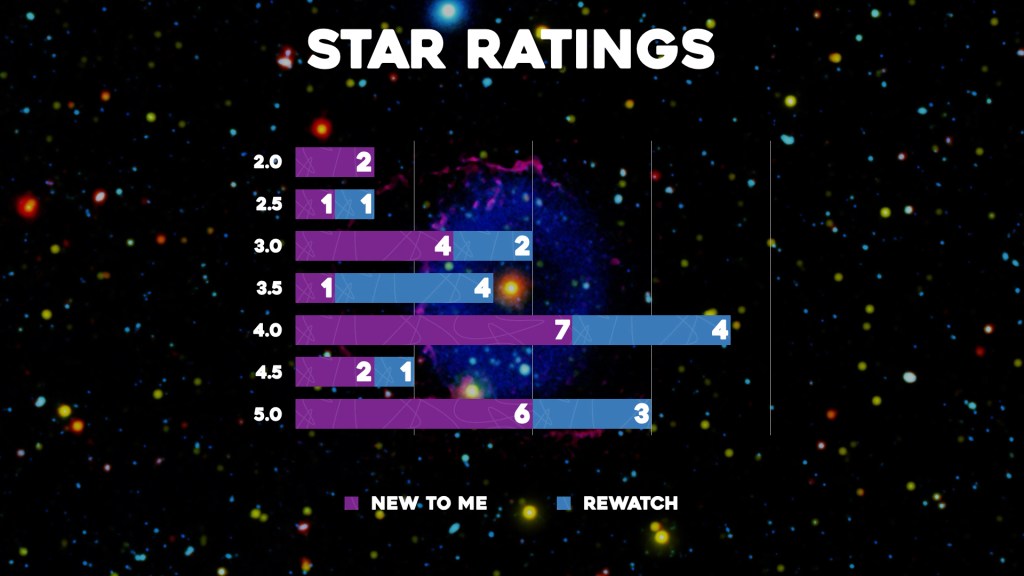
    And now it’s time for the charts and lists!