Title: City of Illusions
(Hainish #3)
Author: Ursula K. Le Guin
Year: 1967
Country: USA
Format: Paperback
Pages: 158
Read: 15 – 21 March 2026
Reread
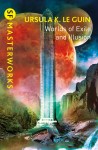
My Hainish series read-through continues with City of Illusions, first published in 1967. (You can also read my reviews of the first two books: Rocannon’s World and Planet of Exile.)
An exhausted, terrified stranger emerges from the forest. His eyes are yellow, cat-like and alien, his memory a complete blank. The forest people take him in, teaching him their language and naming him Falk. He lives happily with them for six years, coming to think of the place as home, but questions of his past still linger. Who was this man before he was Falk? Where is his forgotten home and how did he arrive on Earth? Who erased his memories and why? Falk sets out westward to rediscover his true self, taking him gradually towards a mysterious city inhabited by an elusive, powerful people known as the Shing.
City of Illusions is Ursula K. Le Guin’s third novel, the third part of her Hainish series, and for me it’s the strongest of the three. Le Guin continues to hone her skills, crafting more memorable characters and more evocative prose than before. (The first sentence is only two words long and I found it a more intriguing opening than either of the first two books.) The mysteries of Falk and the Shing kept me engaged throughout, and I enjoyed seeing the connections gradually emerge between the first three Hainish books. It’s a satisfying read that also strengthens what came before it.
Le Guin herself, in her foreword to a later reprinting of the novel, expressed dissatisfaction with the Shing as obvious, uninteresting villains—a character type she generally avoided in her work, preferring to explore more complex themes than hackneyed ol’ Good vs Evil. I can see what she means, but I still enjoyed the book on its own terms, unencumbered as I am by the author’s own artistic vision. Yes, Le Guin would soon go on to better, deeper things, but that doesn’t make this book an artistic failure. I really enjoyed my time with it. City of Illusions may not be Le Guin’s finest work but it certainly set the stage for it.
And, once again, my enjoyment was enhanced by the group reading experience hosted by Gareth (Books Songs and Other Magic). So far I think we’ve all agreed that City of Illusions is the best of Le Guin’s first three books—but everyone seems even more excited for the next entry in the series: The Left Hand of Darkness.
But before that, keep an eye on Gareth’s channel for a livestream discussion of the first three Hainish books.

 A Genteel Black Hole