My year of Project Glowing Rectangle is officially over! Back in late August last year I made the conscious decision to replace some of my doomscrolling time with a more nourishing oblong: cinema.
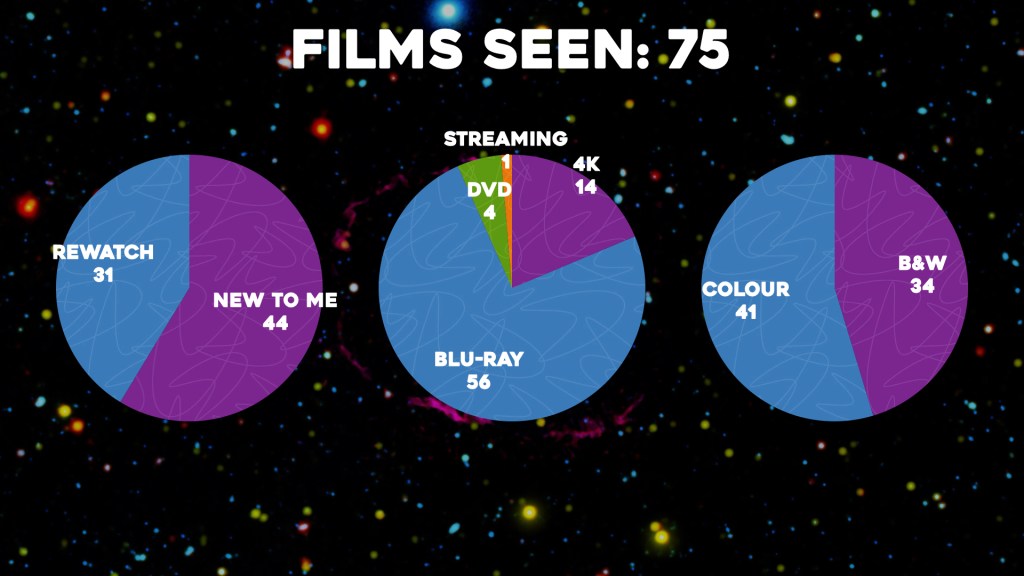
During my twenties, it wasn’t unusual for me to watch over 100 films in a year, but for various reasons my film-viewing habit dried up in my mid-thirties. I’m happy to say Project Glowing Rectangle has successfully revived it. I saw a total of 75 films in the year of PGR. For comparison, in calendar year 2024 I watched a grand total of 16. In 2022 it went as low as 11! In fact, the last time I saw more films in a calendar year was 2017, with a total of 108.
Watching more films helped me reduce my doomscrolling time. More importantly, it enabled me to process my emotions and nourish my soul with some great films. And if I happened to see a disappointing film here and there, it didn’t matter as much; a better one will be on the way soon enough.
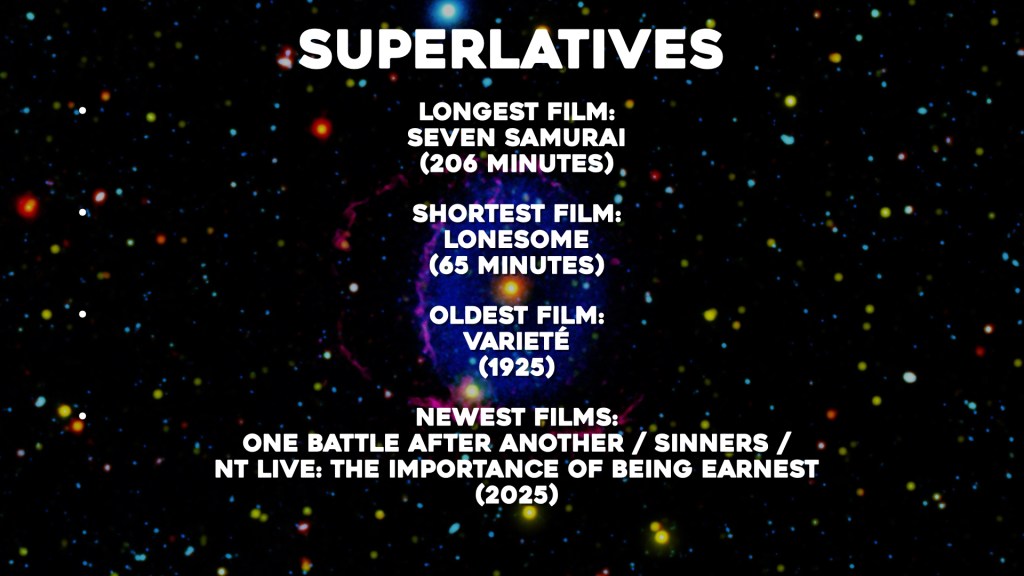
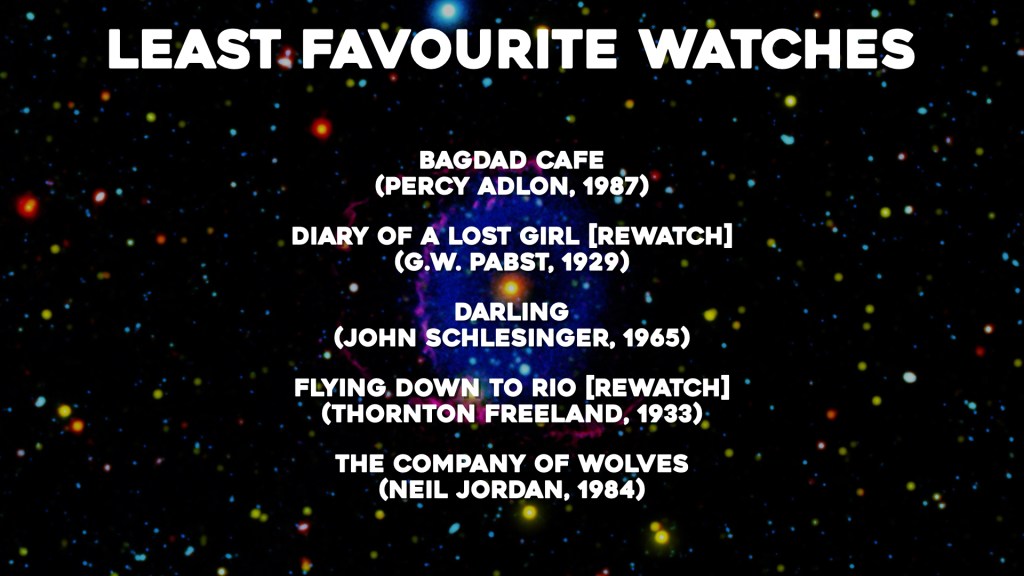
I don’t feel the need to continue tracking PGR into a second year. Now that I’ve successfully revived my love of cinema, the habit should take care of itself, much like my reading does. Future film stats will stick to the calendar year. But here, if you’re at all interested, are the final stats for Project Glowing Rectangle.
Back in the days when I was a teenager, I had a limited music collection. This was before streaming services made practically all recorded music available at the tap of a touchscreen. Back then I could either listen to the radio (which I rarely did), or to one of my select number of CDs. My choices were limited even further when I left the house. Anywhere I went, I took my Walkman with me in a carry case; it had wallet space for a dozen discs. With such limitations, I ended up playing certain albums repeatedly: The Bends, Siamese Dream, Electro-Shock Blues, Grace, etc. I got to know them intimately.
Now I’ve been collecting music for almost three decades. I’ve never taken a full inventory (far too daunting a prospect!) but, between CDs and digital downloads, I must have in excess of a thousand albums. And I have a portable digital music player that can hold every one of those albums. My entire, carefully curated collection at my fingertips, in lossless audio quality. My teenage self would drool at the thought!
With such an accumulated collection to hand, over the past few years I’ve fallen into a habit of listening to sequences of albums. I make a chronological list of everything I own by an artist (or in a given category) and work through it in order. It’s a great way to get an overview of the development of an artist or sub-genre, and it encourages me to revisit music I had been neglecting. But I play each album once and move onto the next. It’s an enjoyable method, but it doesn’t encourage deep listening.
And deep listening is important. Some of my favourite albums weren’t instant hits for me. I wasn’t sure what to think of Cardiacs or Shudder to Think when I first heard them. But something kept me returning to their music, and eventually On Land and in the Sea and Pony Express Record became two of my favourite albums. If I had discovered them more recently, would that still be the case? I, ahem, shudder to think.
So recently I’ve gone back to the listening style of my teenage years. Instead of playing a new purchase just once and moving on, I will keep the best ones in rotation. Some albums take time and repetition to grow on a listener. As Adam Neely repeatedly says: Repetition Legitimises.
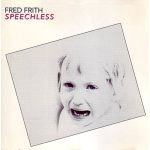
The biggest beneficiary so far of my return to deep listening is Speechless, a 1981 album by Fred Frith. It’s a strange, experimental album which mixes folk music with prog, No Wave, noise, and tape manipulation. When I first played it, I thought to myself, “This is probably really good… but I’d have to give it more spins to love it.” How right I was! Now I keep returning to Speechless, and it gets better every time.
I wonder what other music is waiting to get its hooks into me if I would only give it the chance. I’m excited to find out.
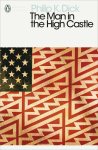
Title: The Man in the High Castle Author: Philip K. Dick Year: 1962 Country: USA
Format: E-book Pages: 256 Read: 17 – 27 April 2026 First reading
A disparate group of characters navigate life in 1960s San Francisco—now part of the Pacific States of America, following the Axis powers’ victory in the Second World War. Robert Childan is an antiques dealer, selling historical Americana to wealthy, prestigious Japanese clients whom he resents. One of Childan’s clients, a high-ranking Japanese official called Mr. Tagomi, needs a gift for a visiting Swedish industrialist called Baynes. Frank Frink, who must hide his Jewish heritage, works for a company that supplies the unsuspecting Childan with counterfeit Civil War antiques. Meanwhile Frank’s estranged wife Juliana, who lives in the neutral territory between America’s Japanese and German states, begins an affair with an Italian truck driver. Each of these characters’ lives are in some way touched by a controversial novel, Hawthorne Abendsen’s The Grasshopper Lies Heavy, which imagines an alternate history where the Allies won the war.
The Man in the High Castle asks plenty of intriguing questions. “What if the Axis powers won the war?” is the first and most obvious question. The answer is quite horrifying. We learn of the Nazis’ destruction of Africa, the ovens in New York, and their plans to betray their wartime allies. But Philip K. Dick uses this scenario to explore plenty of his other preoccupations. The plot about counterfeit antiques asks what counts as genuine anyway, and what therefore counts as fake. (Dick would investigate this idea more thoroughly in Do Androids Dream of Electric Sheep?) Objects have no memory and aren’t materially changed by their mere presence at historical events, so does it matter that Childan’s “antique” guns weren’t really used in the Civil War? Not especially… until someone asks the question.
Then there’s the I Ching, which various characters consult for advice and insight. This is one way in which Dick explores themes of cultural imperialism: the white American characters have Japanese culture imposed upon them, the same way actual America imposes its culture on the world. Dick also mentions the yin-yang cycle—light and dark, each giving birth to its opposite. The yin-yang symbol could be a diagram of this whole book. In reality, Philip K. Dick wrote a novel imagining the Axis powers won the war; in that novel, the fictional Hawthorne Abendsen wrote a book imagining the Allies won. The real and the imagined, each containing its opposite. When Juliana finally meets Abendsen, she discovers Grasshopper was written by consulting the I Ching. She interprets the Oracle’s message to mean that, in some way, the Axis powers really did lose the war. Does this mean that Dick’s own novel implies the reverse in our reality? Given our current situation, maybe he wasn’t far wrong. But the cycle will continue: darkness will again give way to light.
These are all thought-provoking concepts, I really enjoyed pondering them; but the book’s structure and pacing are all over the place. (My buddy-reader Mark found it even more confounding than me! You can see his review on YouTube.) For much of the first half it feels like Philip K. Dick is slowly, meticulously outlining this alternate history, drawing tenuous but intriguing connections between all the main characters. I found myself wondering, half excited and half impatient, where exactly the story was going. Then, for a couple of chapters, there’s a sudden burst of action… which is soon over, giving way to the previous, slow pace. The ending feels less like a crescendo than a fade-out, or a nonchalant shrug. “And things continue pretty much like that—you get it, right?” Ultimately the book gave me a lot to think about, but the actual reading experience was somewhat mixed.
That said, I’m still eager to read more Philip K. Dick.
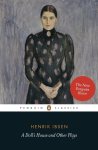
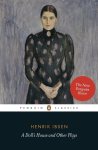
Title: A Doll’s House Author: Henrik Ibsen (Translated by Deborah Dawkin and Erik Skuggevik) Year: 1879 Country: Norway
Format: Paperback Pages: 84 Read: 14 – 16 April 2026 First reading
The Helmers have a seemingly idyllic marriage. Nora is a devoted housewife and mother, and Torvald has just been promoted at work. But Nora has a secret that threatens to destroy their relationship. Years ago Torvald had a breakdown, requiring a rest cure in Italy. Nora let Torvald believe that her late father bequeathed the money that paid for the trip. In fact she borrowed the money illegally by forging signatures. Ever since she has been squirrelling away money, trying to pay off the debt without her husband finding out. But now the moneylender, Krogstad—an employee at Torvald’s bank—is determined to secure a promotion for himself by blackmailing Nora, threatening to reveal the truth.
A Doll’s House is the play that made Ibsen’s name around the world. It was radical in its time and the ending still packs a punch today. The play concerns Nora Helmer’s liberation, her demand for personhood. She realises that the men in her life—first her father, then her husband—have always treated her as their plaything, nothing but a doll to display in their doll’s house. Nora demands a life of her own and the right to make her own mistakes. Her character resonated deeply with me. I too, as a disabled person, have felt marginalised and infantilised—not exactly like Nora, but not dissimilar.
Torvald: You are first and foremost a wife and mother. Nora: I don’t believe that any more. I believe I am first and foremost a human being, I, just as much as you – or at least, that I must try to become one. I know, of course, that most people would say you’re right, Torvald, and that something of the sort is written in books. But I can no longer allow myself to be satisfied with what most people say and what’s written in books. I have to think these things through for myself and see to it I get an understanding of them.
Nora Helmer is one of the greatest ‘classic’ stage roles for women; maybe not as challenging and mercurial as Ibsen’s Hedda Gabler, but a fascinating character at the centre of a powerful, triumphant play. The off-stage sound of Nora slamming the door on her old life still echoes through the ages. I’m so glad the echo finally reached my ear.
Title: John & Paul: A Love Story in Songs Author: Ian Leslie Year: 2025 Country: UK
Format: E-book Pages: 432 Read: 30 March – 13 April 2026 First reading
John Lennon and Paul McCartney met as teenagers in the late 1950s. Paul joined John’s skiffle band, The Quarrymen, and the pair started writing songs together. The Quarrymen gradually morphed into the Beatles, who shot to fame in the ’60s with an impressive run of hit singles and albums mostly written by John and Paul. Towards the end of the decade the band split; each Beatle went on to solo careers of varying success. In 1980, aged just 40, John Lennon was tragically murdered.
If you’re already a Beatles fan that story will sound pretty familiar, but this isn’t a biography of the Beatles as a whole: Ian Leslie focuses squarely on John Lennon and Paul McCartney. A Love Story in Songs is a portrait of their artistic partnership, a rare friendship that was perhaps deeper than a romance. And it’s all told through the music they made; each chapter is based around a specific song.
As a musician myself, I love the way Leslie writes about music. He rightly states that the meaning of a song lies somewhere beyond the literal meaning of the lyrics. The impact of the music—the pure sound of it—imbues the words with new, sometimes conflicting meanings. Music itself speaks to something deep inside for which there is no language, and it’s through this marriage of lyrical and sonic storytelling that the Beatles, and other musicians, truly touch our hearts.
Leslie’s previous books have been about human behaviour, and he brings great insight to his exploration of Lennon and McCartney’s friendship, friendly (and sometimes unfriendly) rivalry, and musical collaboration. He touches on the inherent vulnerability of creative collaboration, and both men’s inability to speak their profound love for one another. Only in song could they express that truth.
If you’d like to hear me talk at length about this book, and my love for the Beatles, I made a full video review on my youtube channel.
Genly Ai is an Envoy for the Ekumen, a sort of interplanetary United Nations. He is sent to the ice planet Gethen (aka Winter) to persuade its constituent countries‚ starting with the nation of Karhide, to join the Ekumen. To Genly the Gethenians are utterly alien: For one thing, they have no concept of gender. Most of the time they are androgynous and asexual, developing the drive and capacity for sex only in the part of their monthly cycle known as kemmer—during which they could become either father or mother to a child. (To them Genly is in permanent kemmer, which they consider a perversion.) Karhidish society is also dictated by shifgrethor, an intricate set of unspoken social rules that Genly finds impossible to understand. So when Prime Minister Estraven, Genly’s chief supporter, is exiled as a traitor, the Envoy finds himself in an increasingly precarious position. Will he find the neighbouring country of Orgoreyn more welcoming?
The Left Hand of Darkness was Ursula K. Le Guin’s breakout hit, winning her first Hugo award and putting her name on the sci-fi map. (Or should I say star chart?) It’s easy to see why: This is a much bolder, more self-assured piece of writing than any of the first three Hainish novels. Le Guin explores her themes with a newfound depth and maturity, asking some big, searching questions about sex, gender, otherness, patriotism and nationalism.
“Hate Orgoreyn? No, how should I? How does one hate a country, or love one? Tibe talks about it; I lack the trick of it. I know people, I know towns, farms, hills and rivers and rocks, I know how the sun at sunset in autumn falls on the side of a certain plowland in the hills; but what is the sense of giving a boundary to all that, of giving it a name and ceasing to love where the name ceases to apply? What is love of one’s country; is it hate of one’s uncountry? Then it’s not a good thing. Is it simply self-love? That’s a good thing, but one mustn’t make a virtue of it, or a profession… Insofar as I love life, I love the hills of the Domain of Estre, but that sort of love does not have a boundary-line of hate. And beyond that, I am ignorant, I hope.”
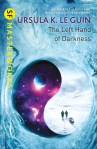
This is a story of two halves—quite apt for a book with a yin-yang symbol on the cover. I find the first half extremely dense. Genly’s field notes explain Gethenian biology, sociology and folklore in meticulous detail, to the point that it honestly threatens to give me a headache. Genly, due to the baffling rules of shifgrethor, doesn’t understand much of what happens to him on Gethen, and I feel similarly out of my depth as a reader. (I had hoped to understand it better on second reading… alas not!) Once Genly and Estraven join forces for an arduous trek across the ice, however, the story finally coalesces. Le Guin narrows her focus to the relationship between two people from different worlds, alternating narrators to let us see their unique perspectives on each other. Only then does it become a deeply emotional story, and one that I ended up loving.
In the first chapter, Genly attends a keystone ceremony. King Argaven places the keystone, the final piece that turns two separate structures into one complete thing: an arch. This is one of the key images of the whole book. Gethen is an isolated planet on its way to joining the Ekumen, becoming part of something bigger than itself; and on a personal level, Genly and Estraven are two aliens gradually finding common ground, forging a deep connection with one another. The more intimate aspect is the one that really captivates me, but both parts are necessary for the story to work. By the end, those two halves have become one complete thing.
The group reading project, hosted by Gareth (Books Songs and Other Magic) continues to be a very rewarding experience. I think we all agreed that The Left Hand of Darkness is our favourite Hainish novel so far, and we’re looking forward to a livestream discussion on Gareth’s channel soon. I’m also excited for the next book in the series: The Word for World is Forest, which I remember being my favourite of the Hainish books I’ve read. After that, the rest of the series will be entirely new to me!
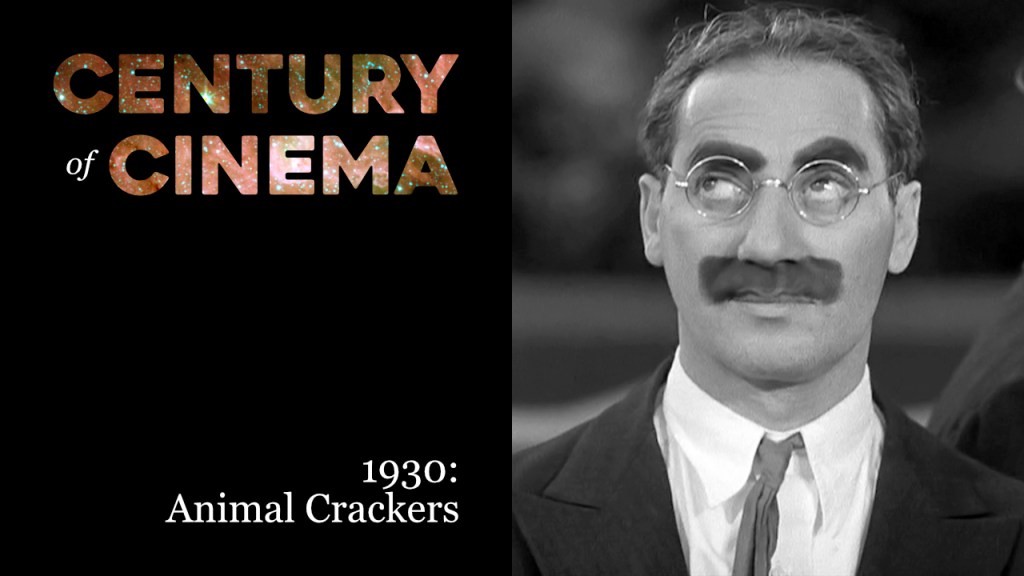
Day 5 of Century of Cinema. Also day 48 of Project Glowing Rectangle, in which I try to divert some of my daily doomscrolling time back towards a more nourishing oblong: Cinema.
Title: Animal Crackers Director: Victor Heerman Writer: Morrie Ryskind Year: 1930 Country: USA
Format: Blu-ray Length: 99 minutes Seen: 22 April 2026 Rewatch
I haven’t made much time for films this past month, but today I finally resumed my Century of Cinema project with Animal Crackers (1930), a Marx Brothers musical comedy directed by Victor Heerman. The first full talkie of the project!
As with most Marx Brothers films, the plot is largely irrelephant. The action takes place at a high society party, hosted by Mrs Rittenhouse (Margaret Dumont), to celebrate the return of the famous explorer Captain Jeffrey T. Spaulding (Groucho)—the T. stands for Edgar. Also at the party are Signor Emanuel Ravelli (Chico) and the Professor (Harpo), a pair of musicians and petty criminals. The two of them get involved in a scheme to steal a valuable painting and replace it with a fake. But when some other guests hit upon a similar plan, all three paintings go missing and chaos ensues.
Captain Spaulding: One morning I shot an elephant in my pajamas. How he got in my pajamas, I don’t know.
Is Animal Crackers a perfect film? No. Did I have a great time watching it? Yes! The Marx Brothers’ madcap antics never fail to delight me. Groucho’s quickfire quips come at a dizzying pace, complemented perfectly by Chico’s malapropisms and Harpo’s silent slapstick. (Zeppo is also there.) Margaret Dumont is the perfect ‘straight man’ amid all the chaos: the stern and stately authority figure for all the Marxes (Groucho especially) to undermine. Then there’s the musical interludes. Chico’s fancy fingerwork on the piano always makes me grin, as does Harpo’s harping. It’s a welcome respite from the otherwise constant madcap energy.
Animal Crackers, being an early talkie and an adaptation of a stage play, has a certain ‘stagey’ quality that might put off some viewers. It took me a few minutes to tune back into that frequency myself. But once I got there, the smile never left my face.
~
On a personal note: I plan to continue blogging Century of Cinema, but I will probably do less blogging of my general film-viewing. The self-imposed pressure of blogging every film I watch has discouraged me from actually watching films, which is supposed to be a relaxing activity to re-centre myself. So from now on I plan to reclaim films as a leisure activity.
Title: Pillars of the Community Author: Henrik Ibsen (Translated by Deborah Dawkin and Erik Skuggevik) Year: 1877 Country: Norway
Format: Paperback Pages: 104 Read: 29 March – 1 April 2026 First reading
Norwegian businessman Karsten Bernick is a well respected man about town, a pillar of the community. His shipbuilding business provides most of the jobs in his small coastal town. Plans for a new railway look set to grow his fortune even further. But his business and his public image are built on a lie. Fifteen years ago his friend Johan took the blame for a scandal that was really Karsten’s doing. In the intervening years the scandal has ballooned thanks to small-town gossip, which Karsten has turned all to his advantage. So when Johan returns from his exile in America, determined to clear his name, it looks like Karsten’s past is about to catch up with him.
Pillars of the Community (more traditionally titled The Pillars of Society) exposes the lie that many prestigious careers are built on. Karsten is involved in insider trading—buying up cheap land, then campaigning in favour of a new railway that will vastly increase the value of said land. He’s a hypocrite, plain and simple. He uses his elevated reputation to justify his unethical actions: it’s okay if he does it, because he creates jobs for the community. The fact that the scheme will also make him unfathomably wealthy is just a happy accident. And as long as he maintains his spotless reputation, the community is bound to agree.
Speaking up for truth is Lona, an unapologetic feminist who is famed in the town for cutting her hair short and wearing (gasp) men’s boots! She was once in love with Karsten, and loved by him, but he rejected her for a marriage of convenience that would advance his career. Lona then followed Johan to America and became his surrogate mother. She returns to Norway with Johan to become the voice of reason, to save Karsten’s soul from his own lies. Like many of Ibsen’s heroines she stands for truth, progress, emancipation, and freedom of spirit. Later he would write deeper, more well-rounded examples of this character type, but Lona is a great early example. She’s easily my favourite character in the play.
This is the earliest of the eight Ibsen plays I’ve read so far. It deals with many of Ibsen’s recurring themes: people haunted by secrets from their past; unearned privilege; lies and hypocrisy; women’s place in modern society; the evils of capitalism; and the tension between tradition and progress. He would tackle all these topics with greater depth and nuance in later plays, but this is still a very enjoyable play in its own right. However the sudden happy ending, where Karsten undergoes a Scrooge-like metamorphosis, feels quite implausible and unearned. Overall,Pillars of the Community is an interesting and engaging play but, in my eyes, not a truly great one.
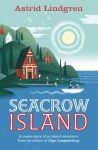
Title: Seacrow Island (Seacrow Island #1) Author: Astrid Lindgren (Translated by Evelyn Ramsden) Year: 1964 Country: Sweden
Format: E-book Pages: 274 Read: 17 – 29 March 2026 First reading
Melker Melkerson is a widowed father with an impulsive, childlike nature. He rents a cottage for the summer, sight unseen, just because he likes the name of the location: Seacrow Island. When Melker and his four children arrive on the island, they’re distressed to find the cottage cold, leaky and dilapidated. But over the summer they befriend the residents of Seacrow Island, grow to love the cottage, and gradually come to think of the place as home. Wouldn’t it be nice to live there all year round?
I liked Seacrow Island well enough, I suppose: I read the whole thing… but it just didn’t sing to me. Perhaps I was hoping for too much. I found it in a list of recommendations for Moomin fans. Having recently finished the entire Moomin series, I was looking for something else to scratch that itch. Seacrow Island… didn’t. If there is another fictional family like the Moomins, the Melkersons ain’t it!
They’re a sweet enough bunch of characters—especially the youngest brother Pelle, a devoted animal lover. But I found it hard to care much about the Melkersons’ adventures on Seacrow Island. The whole thing felt quite predictable to me. I could tell from the first chapter they would grow to love the island and decide to move there permanently. Watching that inevitable story unfold didn’t strike me as particularly compelling.
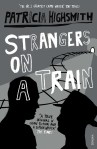
Two strangers, up-and-coming architect Guy Haines and wealthy drunkard Charles Anthony Bruno, meet by chance on a train. As the two men talk it becomes clear that Bruno is obsessed with murder. He outlines his plan for the perfect murder, or rather the perfect pair of murders. Each man would do the other’s dirty work, ensuring there’s no motive connecting him to his respective crime. Bruno even proposes the ideal victims: His father, and Guy’s estranged wife Miriam. Guy protests he’s not the type to commit murder. But Bruno insists there is no “type”, that any man can kill given the right circumstances. And when Bruno goes ahead and strangles Miriam for Guy, it sets in motion a series of events which lead inexorably to Guy fulfilling his half of the bargain.
I first read Strangers on a Train just over a decade ago. Back then I found it faintly underwhelming, perhaps because the fun and thrilling Hitchcock film was fresh in my memory—as was Highsmith’s excellent book, The Talented Mr Ripley. Honestly I’m not really sure what I was thinking. This time I was able to better appreciate Strangers on a Train for what it is… and I loved every second!
This is a remarkable debut novel, much deeper and darker than the film it inspired. It’s a study of the ugliest recesses of the human psyche, exposing how a perfectly ordinary man can be driven to kill. “What else do you think keeps the totalitarian states going?” Highsmith paints both Guy and Bruno vividly, with disturbing insight. Their thought processes are laid out in detail; every paranoid spiral, every hateful and violent impulse. It may lack some of the action set-pieces of Hitchcock’s adaptation*, but it had me constantly gripped by the guts.
The story also has a strong homoerotic subtext. Guy and Bruno share a profound connection, one that must be repressed and hidden at all costs—yet they can’t keep away from each other. Bruno even plies Guy with gifts, desperately seeking his approval. These are compelling, queer, obsessive themes that Highsmith would revisit throughout her career.
I’m not sure why I drifted away from Patricia Highsmith, having initially been so thrilled to discover her. Revisiting Strangers on a Train has suddenly reignited my enthusiasm in a big way. I’m excited to explore more of her books in the future, rereading the ones I remember fondly and trying some new ones too. My reading schedule is already looking pretty full, but I really hope to make time for more Highsmith this year.
*Interestingly, the climactic merry-go-round scene in the Hitchcock film was taken, uncredited, from an entirely different book: The Moving Toyshop by Edmund Crispin.










 A Genteel Black Hole