Day 2 of Century of Cinema. Also day 42 of Project Glowing Rectangle, in which I try to divert some of my daily doomscrolling time back towards a more nourishing oblong: Cinema.
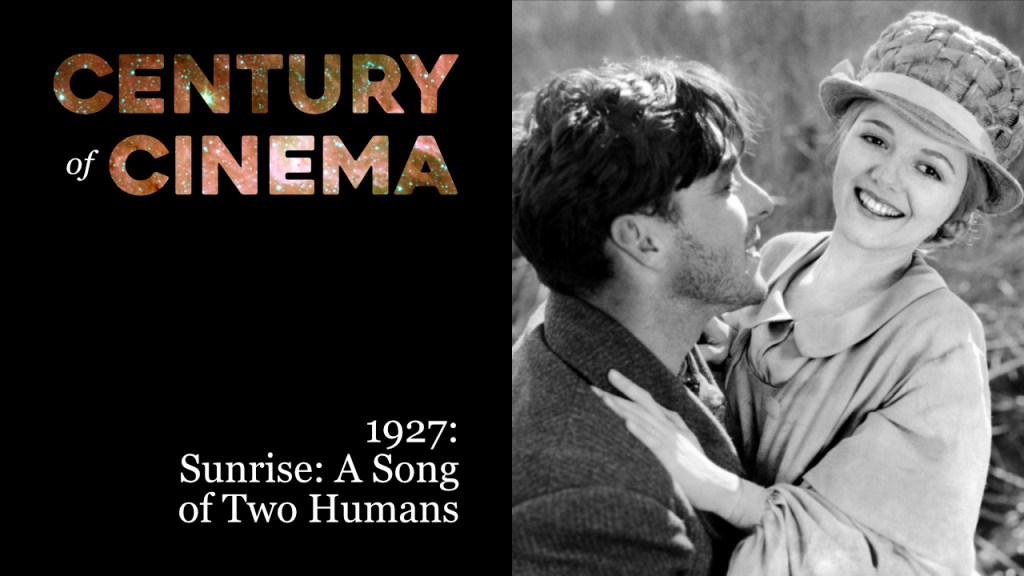
Title: Sunrise: A Song of Two Humans
Director: F.W. Murnau
Writer: Carl Mayer
Year: 1927
Country: USA
Format: Blu-ray
Length: 95 minutes
Seen: 6 March 2026
Rewatch
Picking a film for 1927 was tricky. This was the year that gave us the seminal sci-fi classic Metropolis, and the Oscars’ first Best Picture, Wings. But in the end I settled for the first American film by German Expressionist pioneer F.W. Murnau: Sunrise: A Song of Two Humans.
A Man (George O’Brien) is seduced by a glamorous Woman From the City (Margaret Livingston), who persuades him to murder his Wife (Janet Gaynor). The Man takes his Wife out in a rowboat, planning to push her overboard. But as she cowers and pleads for mercy, he is stricken with guilt and cannot do the terrible deed. He begs her forgiveness, but can their fractured relationship be healed?
Sunrise: A Song of Two Humans won three of the first ever Academy Awards. One was for cinematography, one for Janet Gaynor’s performance. Its third Oscar was in a category never since repeated: Unique and Artistic Picture. (I wish they’d bring that one back!) It’s almost a mirror image of another film I watched recently: Varieté. That film started with a man leaving his wife and ends in murder; this one starts with attempted murder and ends in reconciliation. I question whether reconciliation with a would-be murderer is really A Good Thing, but Sunrise is such a visually stunning piece of cinematic storytelling, I find myself swept along by it regardless.
The film uses a variety of German Expressionist techniques to vividly evoke the characters’ emotional landscapes. There are too many enchanting images to count. I particularly love the shot of the Man surrounded by ghostly images of the Woman From the City, clinging to him seductively as he contemplates the murder of his Wife.
Its use of sound is equally inventive. Despite being a “silent” film, it came with an early example of a synchronised soundtrack—no “talkie” dialogue, just music and occasional sounds effects. The music, like the imagery, overlaps different styles and tones to create complex sonic textures.
Sunrise is an incredibly evocative film. Admittedly it has an uneven structure and a troubling central premise, but the sheer artistry of its construction kept me utterly beguiled.

 A Genteel Black Hole