Title: The Left Hand of Darkness
(Hainish #4)
Author: Ursula K. Le Guin
Year: 1969
Country: USA
Format: Paperback
Pages: 300
Read: 2 – 13 April 2026
Reread
Genly Ai is an Envoy for the Ekumen, a sort of interplanetary United Nations. He is sent to the ice planet Gethen (aka Winter) to persuade its constituent countries‚ starting with the nation of Karhide, to join the Ekumen. To Genly the Gethenians are utterly alien: For one thing, they have no concept of gender. Most of the time they are androgynous and asexual, developing the drive and capacity for sex only in the part of their monthly cycle known as kemmer—during which they could become either father or mother to a child. (To them Genly is in permanent kemmer, which they consider a perversion.) Karhidish society is also dictated by shifgrethor, an intricate set of unspoken social rules that Genly finds impossible to understand. So when Prime Minister Estraven, Genly’s chief supporter, is exiled as a traitor, the Envoy finds himself in an increasingly precarious position. Will he find the neighbouring country of Orgoreyn more welcoming?
The Left Hand of Darkness was Ursula K. Le Guin’s breakout hit, winning her first Hugo award and putting her name on the sci-fi map. (Or should I say star chart?) It’s easy to see why: This is a much bolder, more self-assured piece of writing than any of the first three Hainish novels. Le Guin explores her themes with a newfound depth and maturity, asking some big, searching questions about sex, gender, otherness, patriotism and nationalism.
“Hate Orgoreyn? No, how should I? How does one hate a country, or love one? Tibe talks about it; I lack the trick of it. I know people, I know towns, farms, hills and rivers and rocks, I know how the sun at sunset in autumn falls on the side of a certain plowland in the hills; but what is the sense of giving a boundary to all that, of giving it a name and ceasing to love where the name ceases to apply? What is love of one’s country; is it hate of one’s uncountry? Then it’s not a good thing. Is it simply self-love? That’s a good thing, but one mustn’t make a virtue of it, or a profession… Insofar as I love life, I love the hills of the Domain of Estre, but that sort of love does not have a boundary-line of hate. And beyond that, I am ignorant, I hope.”
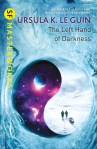
This is a story of two halves—quite apt for a book with a yin-yang symbol on the cover. I find the first half extremely dense. Genly’s field notes explain Gethenian biology, sociology and folklore in meticulous detail, to the point that it honestly threatens to give me a headache. Genly, due to the baffling rules of shifgrethor, doesn’t understand much of what happens to him on Gethen, and I feel similarly out of my depth as a reader. (I had hoped to understand it better on second reading… alas not!) Once Genly and Estraven join forces for an arduous trek across the ice, however, the story finally coalesces. Le Guin narrows her focus to the relationship between two people from different worlds, alternating narrators to let us see their unique perspectives on each other. Only then does it become a deeply emotional story, and one that I ended up loving.
In the first chapter, Genly attends a keystone ceremony. King Argaven places the keystone, the final piece that turns two separate structures into one complete thing: an arch. This is one of the key images of the whole book. Gethen is an isolated planet on its way to joining the Ekumen, becoming part of something bigger than itself; and on a personal level, Genly and Estraven are two aliens gradually finding common ground, forging a deep connection with one another. The more intimate aspect is the one that really captivates me, but both parts are necessary for the story to work. By the end, those two halves have become one complete thing.
The group reading project, hosted by Gareth (Books Songs and Other Magic) continues to be a very rewarding experience. I think we all agreed that The Left Hand of Darkness is our favourite Hainish novel so far, and we’re looking forward to a livestream discussion on Gareth’s channel soon. I’m also excited for the next book in the series: The Word for World is Forest, which I remember being my favourite of the Hainish books I’ve read. After that, the rest of the series will be entirely new to me!

