Day 3 of Century of Cinema. Also day 43 of Project Glowing Rectangle, in which I try to divert some of my daily doomscrolling time back towards a more nourishing oblong: Cinema.
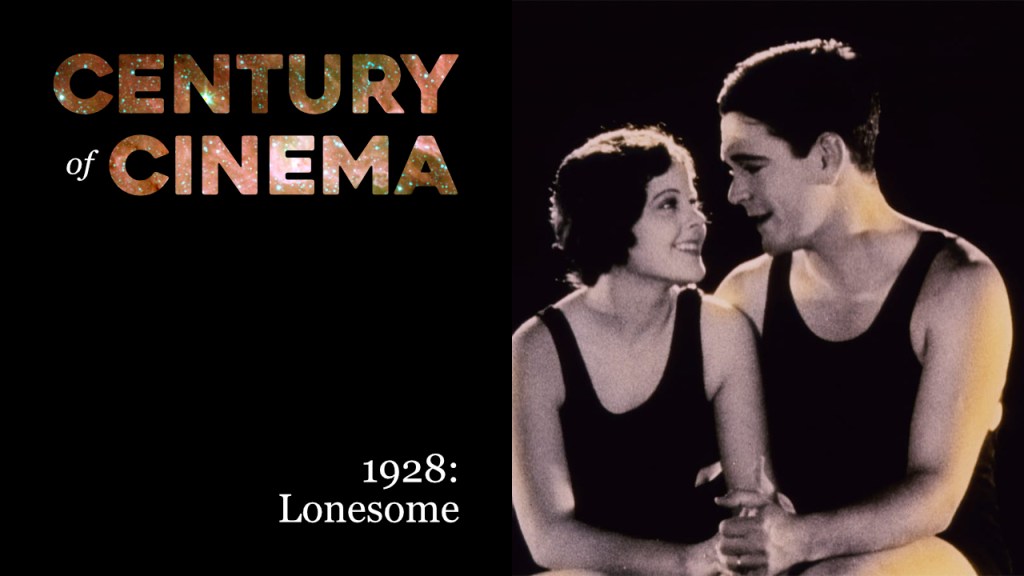
Title: Lonesome
Director: Paul Fejös
Writer: Tom Reed, Edward T. Lowe Jr
Year: 1928
Country: USA
Format: Blu-ray
Length: 65 minutes
Seen: 12 March 2026
Rewatch
Picking my 1928 film wasn’t quite as tricky as 1927… but it still wasn’t easy. I could easily rule out two Buster Keaton films (Steamboat Bill Jr and The Cameraman), since I started this whole project with Buster. And I eliminated Fritz Lang’s Spione (Spies) because I wasn’t in the mood for such a long film today. That left me with two possibilities. I was tempted by Speedy, a Harold Lloyd vehicle I’ve only seen once before. But in the end I went for Lonesome (1928), a mostly-silent romance directed by Paul Fejös.
Among the crowds of New York City, Mary (Barbara Kent) and Jim (Glenn Tryon) each live alone. Every morning they rush to work, then come home at night to empty apartments. When the two meet by chance at Coney Island, it’s love at first sight. They spend a whirlwind evening together at the funfair, quickly confessing their love for one another. But when the pair are separated just as suddenly as they met, can they ever find each other again?
Lonesome is a very sweet little film about two lonely people finding love. Fejös finds some visually creative ways to evoke the stress and drudgery of their busy workdays, as well as the chaos of the crowded funfair at which they meet. Some scenes have hand-tinted colour, adding an extra visual ‘pop’. The two stars make a cute couple onscreen, I found myself rooting for them immediately. But things grind to a halt during the studio-mandated talkie scenes. The roving camera is suddenly locked to one angle, the actors forced into stilted vocal performances that can’t match the charm of their expressive silent faces. Talkies were still very new at this point—and it shows!
In many ways this is a good companion to Sunrise: A Song of Two Humans. Both films were made during the last gasp of silent cinema, both are very visually creative, and both centre on the fate of a couple. But while Sunrise is about a married couple repairing their broken relationship, Lonesome is a much lighter, sweeter film about the first flushes of love. I’d say Sunrise is a better constructed, more compelling film, but Lonesome certainly has its charm.
It’s just a shame about those clunky talkie scenes.
 A Genteel Black Hole
Leave a comment