Tag: reviews

  • Day 3 of Century of Cinema. Also day 43 of Project Glowing Rectangle, in which I try to divert some of my daily doomscrolling time back towards a more nourishing oblong: Cinema.
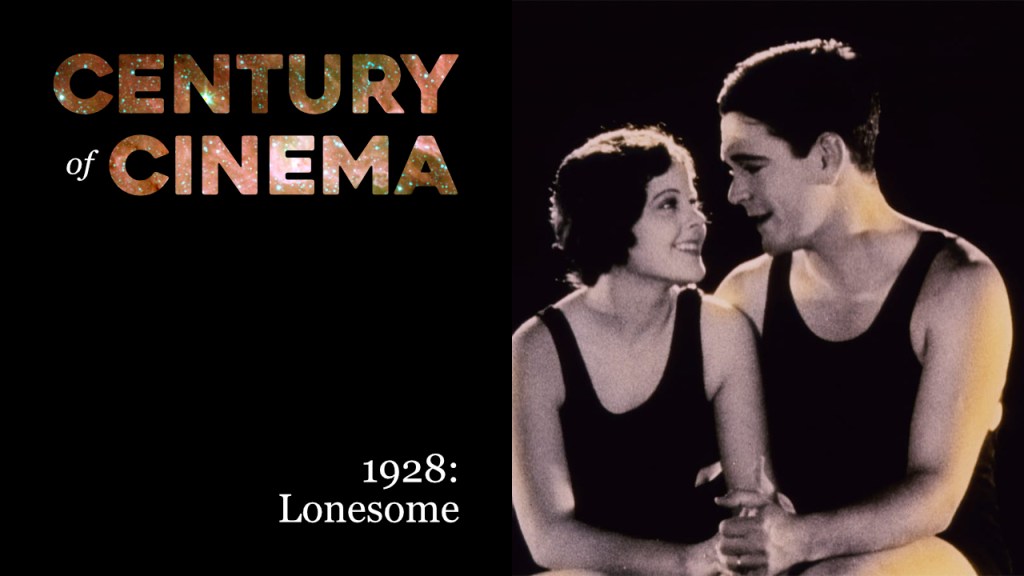
    Title: Lonesome
    Director: Paul Fejös
    Writer: Tom Reed, Edward T. Lowe Jr
    Year: 1928
    Country: USA

    Format: Blu-ray
    Length: 65 minutes
    Seen: 12 March 2026
    Rewatch

    Picking my 1928 film wasn’t quite as tricky as 1927… but it still wasn’t easy. I could easily rule out two Buster Keaton films (Steamboat Bill Jr and The Cameraman), since I started this whole project with Buster. And I eliminated Fritz Lang’s Spione (Spies) because I wasn’t in the mood for such a long film today. That left me with two possibilities. I was tempted by Speedy, a Harold Lloyd vehicle I’ve only seen once before. But in the end I went for Lonesome (1928), a mostly-silent romance directed by Paul Fejös.

    Among the crowds of New York City, Mary (Barbara Kent) and Jim (Glenn Tryon) each live alone. Every morning they rush to work, then come home at night to empty apartments. When the two meet by chance at Coney Island, it’s love at first sight. They spend a whirlwind evening together at the funfair, quickly confessing their love for one another. But when the pair are separated just as suddenly as they met, can they ever find each other again?

    Lonesome is a very sweet little film about two lonely people finding love. Fejös finds some visually creative ways to evoke the stress and drudgery of their busy workdays, as well as the chaos of the crowded funfair at which they meet. Some scenes have hand-tinted colour, adding an extra visual ‘pop’. The two stars make a cute couple onscreen, I found myself rooting for them immediately. But things grind to a halt during the studio-mandated talkie scenes. The roving camera is suddenly locked to one angle, the actors forced into stilted vocal performances that can’t match the charm of their expressive silent faces. Talkies were still very new at this point—and it shows!

    In many ways this is a good companion to Sunrise: A Song of Two Humans. Both films were made during the last gasp of silent cinema, both are very visually creative, and both centre on the fate of a couple. But while Sunrise is about a married couple repairing their broken relationship, Lonesome is a much lighter, sweeter film about the first flushes of love. I’d say Sunrise is a better constructed, more compelling film, but Lonesome certainly has its charm.

    It’s just a shame about those clunky talkie scenes.
  • Day 2 of Century of Cinema. Also day 42 of Project Glowing Rectangle, in which I try to divert some of my daily doomscrolling time back towards a more nourishing oblong: Cinema.

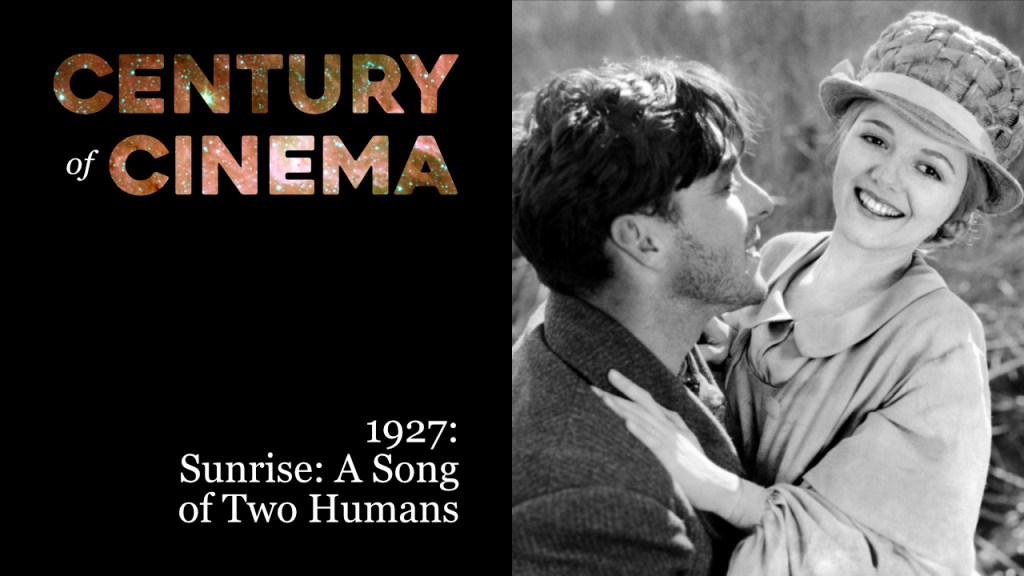
    Title: Sunrise: A Song of Two Humans
    Director: F.W. Murnau
    Writer: Carl Mayer
    Year: 1927
    Country: USA

    Format: Blu-ray
    Length: 95 minutes
    Seen: 6 March 2026
    Rewatch

    Picking a film for 1927 was tricky. This was the year that gave us the seminal sci-fi classic Metropolis, and the Oscars’ first Best Picture, Wings. But in the end I settled for the first American film by German Expressionist pioneer F.W. Murnau: Sunrise: A Song of Two Humans.

    A Man (George O’Brien) is seduced by a glamorous Woman From the City (Margaret Livingston), who persuades him to murder his Wife (Janet Gaynor). The Man takes his Wife out in a rowboat, planning to push her overboard. But as she cowers and pleads for mercy, he is stricken with guilt and cannot do the terrible deed. He begs her forgiveness, but can their fractured relationship be healed?

    Sunrise: A Song of Two Humans won three of the first ever Academy Awards. One was for cinematography, one for Janet Gaynor’s performance. Its third Oscar was in a category never since repeated: Unique and Artistic Picture. (I wish they’d bring that one back!) It’s almost a mirror image of another film I watched recently: Varieté. That film started with a man leaving his wife and ends in murder; this one starts with attempted murder and ends in reconciliation. I question whether reconciliation with a would-be murderer is really A Good Thing, but Sunrise is such a visually stunning piece of cinematic storytelling, I find myself swept along by it regardless.

    The film uses a variety of German Expressionist techniques to vividly evoke the characters’ emotional landscapes. There are too many enchanting images to count. I particularly love the shot of the Man surrounded by ghostly images of the Woman From the City, clinging to him seductively as he contemplates the murder of his Wife.

    Its use of sound is equally inventive. Despite being a “silent” film, it came with an early example of a synchronised soundtrack—no “talkie” dialogue, just music and occasional sounds effects. The music, like the imagery, overlaps different styles and tones to create complex sonic textures.

    Sunrise is an incredibly evocative film. Admittedly it has an uneven structure and a troubling central premise, but the sheer artistry of its construction kept me utterly beguiled.

  • Day 38 of Project Glowing Rectangle, in which I try to divert some of my daily doomscrolling time back towards a more nourishing oblong: Cinema.

    Title: The Apartment
    Director: Billy Wilder
    Writer: Billy Wilder, I. A. L. Diamond
    Year: 1960
    Country: USA

    Format: 4K Blu-ray
    Length: 125 minutes
    Seen: 18 February 2026
    Rewatch

    Kubelik: Some people take, some people get took. And they know they’re getting took and there’s nothing they can do about it.

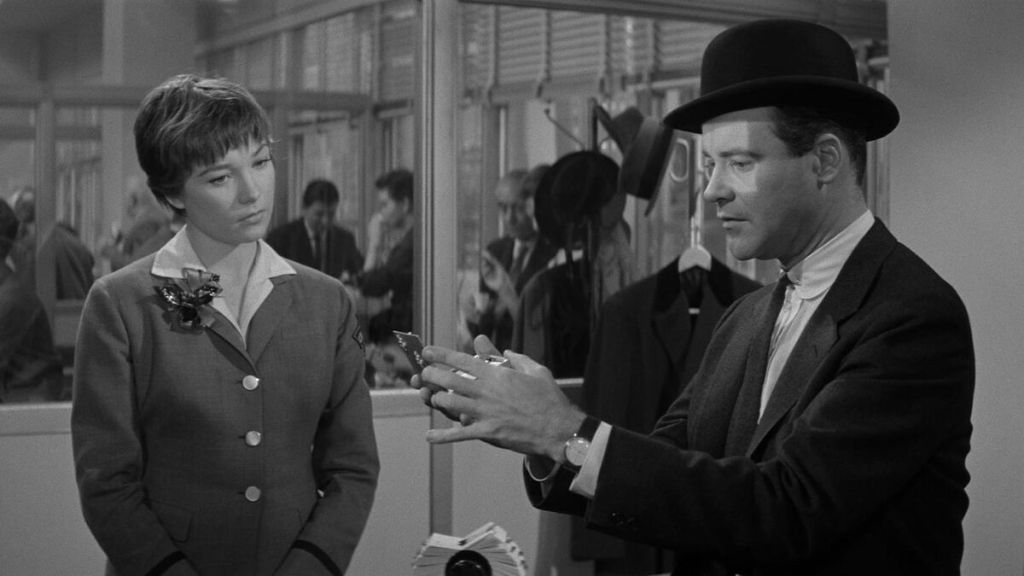
    C. C. Baxter (Jack Lemmon), aka Buddy Boy, is one of those people who gets took. He works in a huge office building as an insurance clerk, his head stuffed with numbers and statistics. Baxter often works late, not out of dedication to his job but because, despite living alone, his apartment is rarely empty. His key gets passed around the office, his apartment serving as a discreet place for married men to take their girlfriends. In return, Baxter’s superiors recommend him for promotions. When he agrees to lend the key to Mr Sheldrake (Fred MacMurray), director of personnel, Baxter finds himself quickly ascending the corporate ladder. Meanwhile he harbours a crush on Miss Kubelik (Shirley MacLaine), an elevator operator at the office. Little does he know she’s already been to his apartment…

    Baxter: The mirror… it’s broken.
    Kubelik: Yes, I know. I like it that way. Makes me look the way I feel.

    It’s safe to say The Apartment is my favourite film of all time. My band’s debut album, The Way It Crumbles, was named after a quote from the film. I rewatched it today to celebrate my 40th birthday and it made me smile, laugh and blub as much as ever! It’s a beautiful film about loneliness, human connection, and the importance of growing a spine and doing the right thing—or, as Baxter’s neighbour Dr Dreyfuss (Jack Kruschen) puts it, being a mensch.

    Jack Lemmon and Shirley MacLaine are fantastic as Baxter and Kubelik, and the screenplay by Billy Wilder and I. A. L. Diamond is a well-oiled machine of setups and payoffs. Baxter has a habit of quoting all the other characters, picking up their verbal tics and mannerisms. This leads to so many running gags and references throughout the film, each one gaining new significance over time. Nobody quotes Baxter in return, at least not at first. But eventually Miss Kubelik starts to pick up Baxterisms and the two are drawn together, romance-wise. It’s a rather chaste romance, one that ends not with a passionate kiss but a game of cards. It feels to me like a very neurodivergent-coded romcom. I love it deeply.

  • I’ve been tracking my film viewing since 2012. That year, at the height of my obsession, I watched 161 films! By the end of the decade, things had settled down to a more reasonable level, about 50 or 60 per year. But in 2022, due to a mixture of creative projects and health disasters, I watched just 11 films—and for the next couple of years that number didn’t go above 17. With less time spent on films, my doomscrolling ballooned.

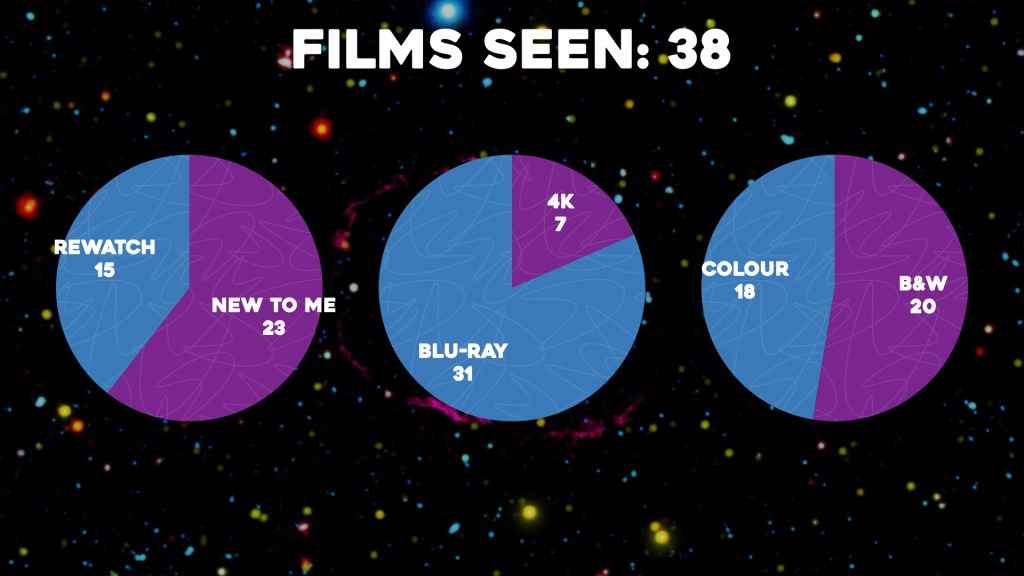
    Enter Project Glowing Rectangle, my personal effort to simultaneously get my phone habit under control and reclaim my love of cinema: Two birds, one Sharon Stone! I started the project in late August 2025. By the end of the year I had watched 38 films, of which only 9 were pre-Rectangle.

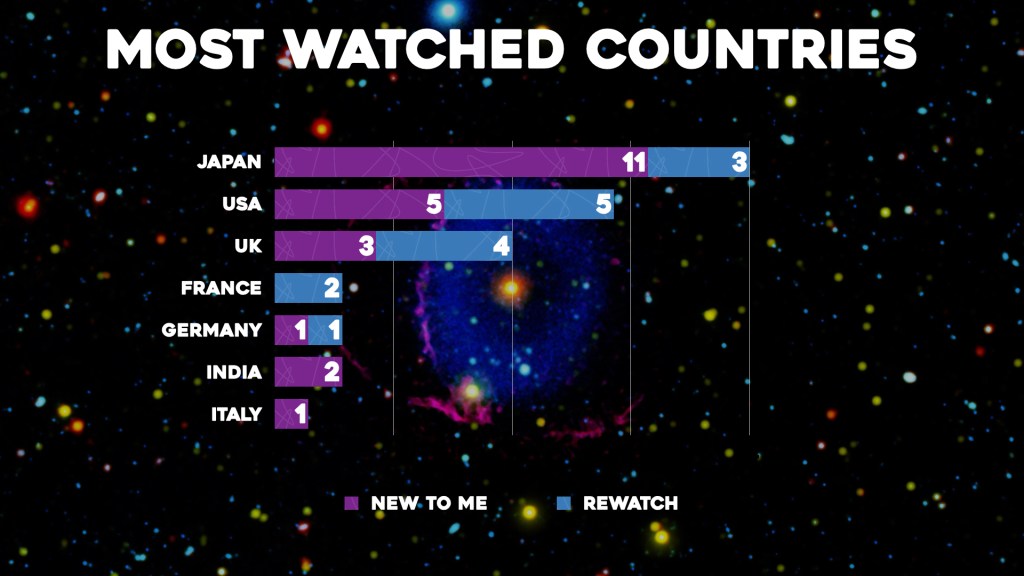
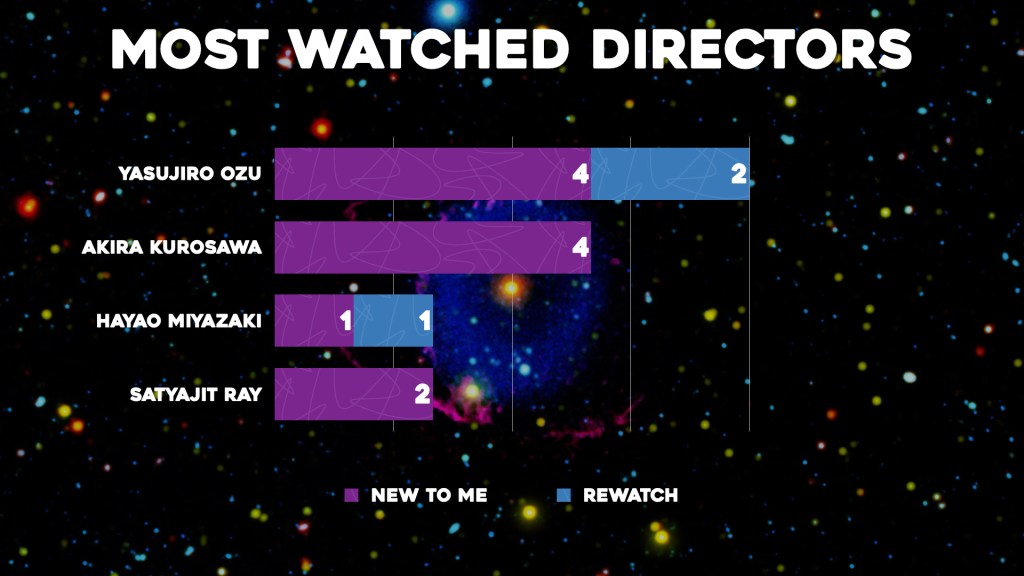
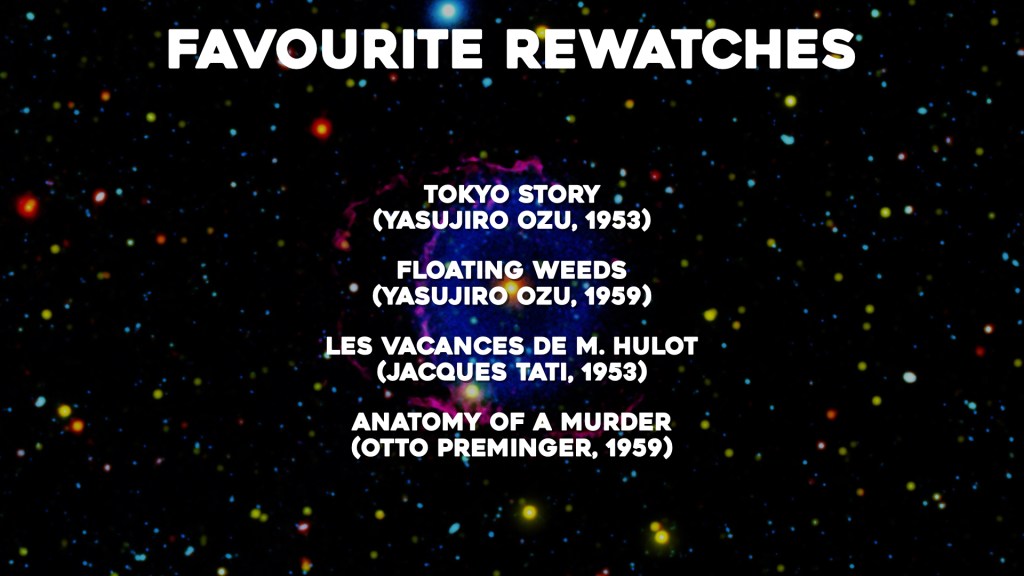
    But numbers don’t tell the whole story. What actually happened is that I fell back in love with cinema. I had several transcendent movie experiences during the year. While my 2010s film binge was kickstarted by the Golden Age of Hollywood, my recent cinematic renaissance had a more Japanese flavour. I started the project with a rewatch of Yasujiro Ozu’s Floating Weeds and ended the year with Kiyoshi Kurosawa’s Cure. And that’s just two of the 14 Japanese films I watched—nearly all of them great! Ugetsu and Seven Samurai were two standouts, both seen for the first time in November. And Yasujiro Ozu has become a real favourite filmmaker for me: I watched the entire Noriko Trilogy and several more besides, and loved them all. I’m excited to explore more of his work in the coming year, as well as more Mizoguchi, Kurosawa, and other Japanese classics on my radar.

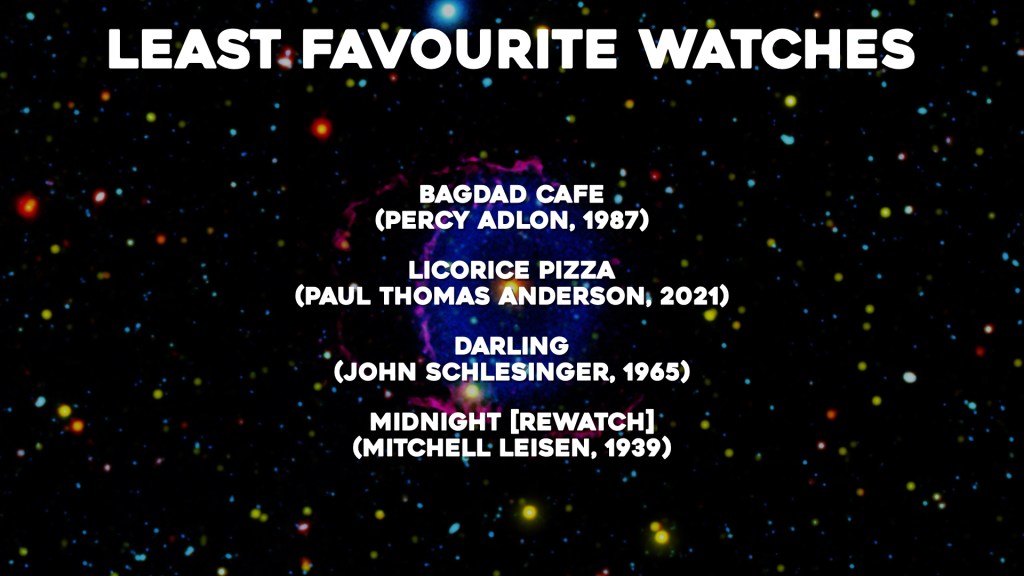
    Most of my biggest disappointments came pre-Rectangle. Miyazaki’s The Boy and the Heron was underwhelming, and Paul Thomas Anderson’s Licorice Pizza was a real slog. Then there’s Mitchell Leisen’s Midnight, a screwball comedy co-written by the great Billy Wilder. I was excited to watch it, only to find it utterly forgettable. So forgettable, in fact, I had already forgotten it! When I went to log it on Letterboxd, I was baffled to discover I had already watched it a decade ago; the rewatch hadn’t jogged my memory at all. Even if I couldn’t necessarily tell you what a film was about, I can usually at least remember that I’ve seen it! Maybe I’m getting old…

    Anyway, Project Glowing Rectangle has been a rousing success. Getting back into cinema feels like reclaiming a lost part of myself. It’s good to start feeling more like Me. I’m excited to see what cinematic discoveries await me in 2026.

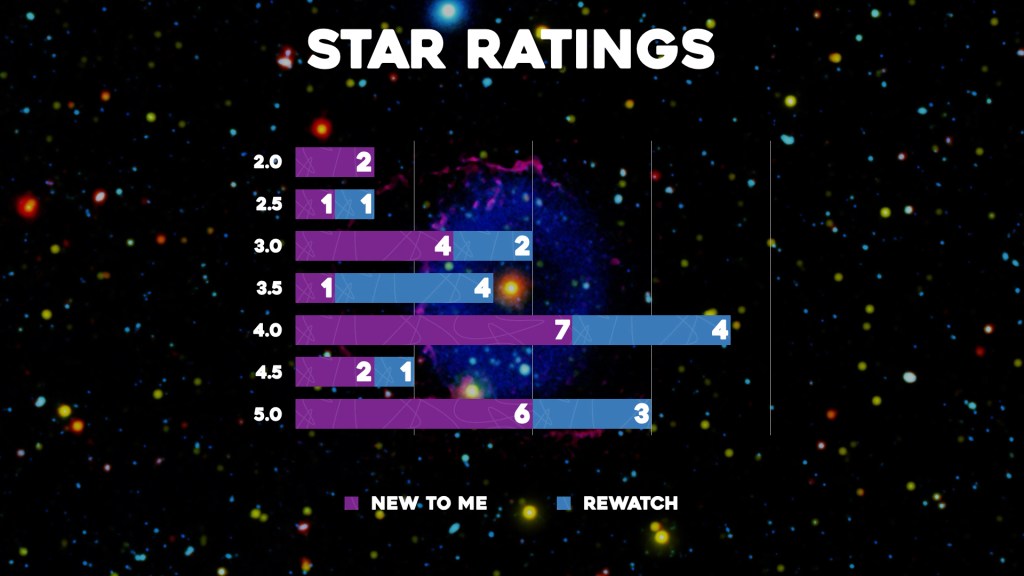
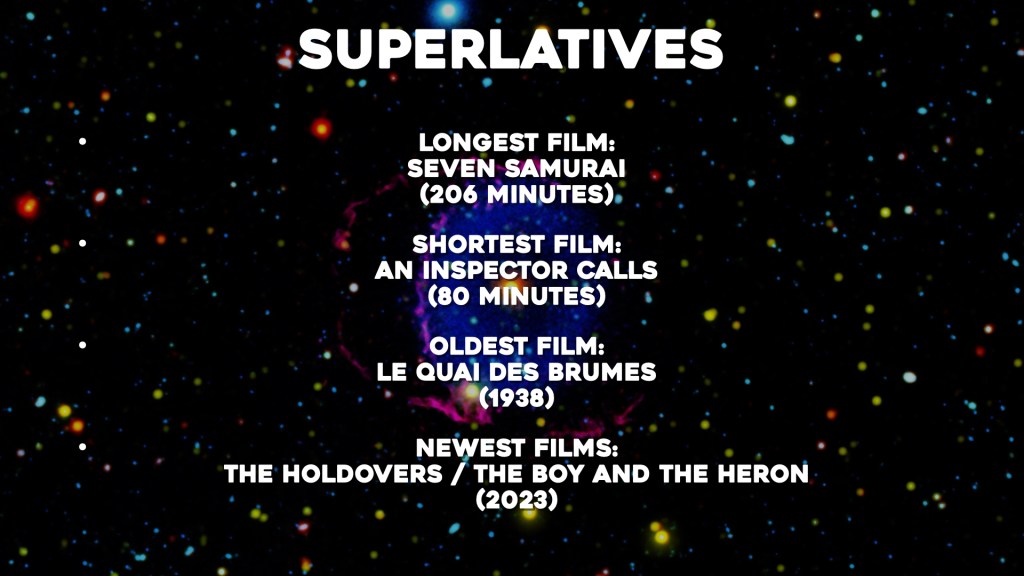
    And now it’s time for the charts and lists!